Anonymous Couple
Years Struggled
2 yrs
Treatment
IVF
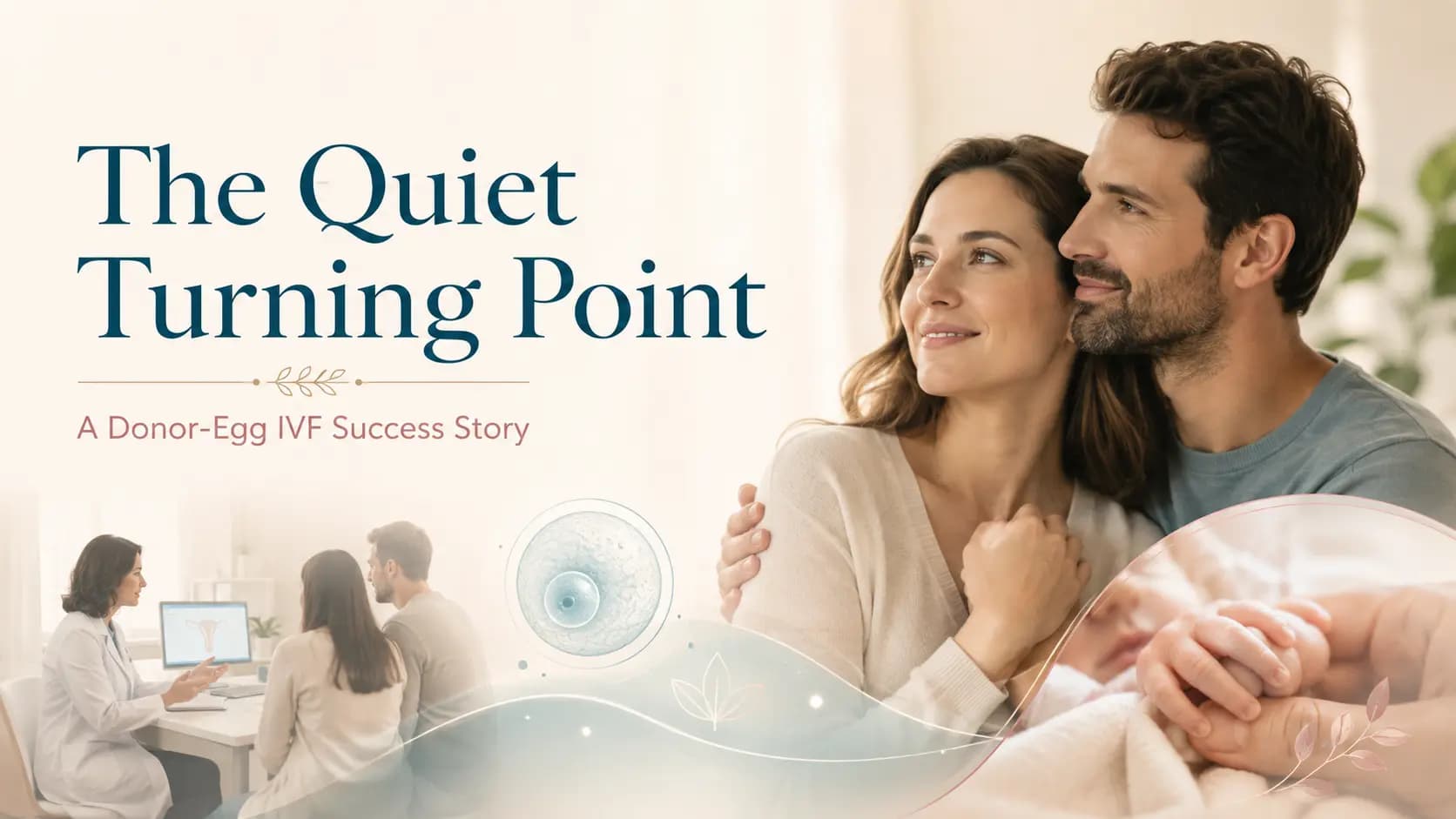
“After multiple failed IVF attempts, choosing donor-egg IVF gave us renewed hope. Our second embryo transfer resulted in a healthy pregnancy and the baby we had been waiting for. This journey taught us that motherhood is defined by love, not genetics.”
In the world of fertility treatment, time is not merely a measure of days and months. It is a biological force, a silent partner in every IVF cycle, shaping outcomes in ways that are often invisible until they become undeniable. As an IVF counsellor, I witness this truth unfold in the lives of the women and couples who come to me seeking clarity, courage, and direction. Among the many decisions they face, few are as emotionally charged as the choice to proceed with donor eggs. And yet, when made at the right moment, this decision can open the door to the very future they have been longing for.
One woman’s journey illustrates this with striking clarity.
She first reached out in May, hopeful and determined. Her own fertility reports were reassuring, but her husband’s showed abnormal sperm morphology — a male‑factor concern that can quietly influence embryo development. Despite this, she moved forward with IVF at a well‑known clinic, trusting the process and hoping for a successful outcome. Eight eggs were retrieved, five embryos formed, and two transfers were attempted. Both failed. The emotional weight of these failures pushed her into silence, a pause that felt necessary but would later prove costly.
Months passed before she reconnected in December. She was now thirty‑seven, an age where egg quality naturally declines and chromosomal abnormalities become more common. Her second IVF cycle in Delhi confirmed what biology had already begun to signal. Although her eggs appeared healthy, PGT‑A testing revealed that every embryo was chromosomally abnormal. The medical path was clear: donor eggs were the only viable option.
This is the moment where many women hesitate. Not because they doubt the science, but because the heart needs time to accept what the mind already knows. She took nearly half a year to process the idea, to grieve the expectations she once held, and to prepare herself emotionally for a donor‑egg cycle. This emotional journey is valid, human, and deeply personal. Yet medically, time continued its quiet work. The uterus, too, has a biological clock. Receptivity changes. Hormonal response shifts. And every delay can make the next step more challenging.
When she finally embraced the donor‑egg pathway, the transformation was remarkable. With donor eggs and her husband’s improved sperm quality — strengthened through months of antioxidants — seven robust embryos were created. The first transfer brought hope and then heartbreak. The second brought the joy she had been waiting for. A healthy pregnancy. A thriving baby. And today, when you see the child, there is no trace of the donor‑egg journey. There is only love, connection, and the unmistakable bond of a mother and her child.
This story is not just about medical outcomes. It is about the profound truth that genetics do not define motherhood. Biology may shape the beginning, but love shapes everything that follows. A child born through donor eggs is not “less yours.” They are yours entirely — in every heartbeat, every smile, every moment.
The Emotional Landscape: What Women Really Feel
Choosing donor eggs is not simply a medical decision. It is an emotional turning point. Women often grapple with questions about identity, genetics, and the meaning of motherhood. They wonder whether the child will feel like theirs, whether others will know, and whether they are “giving up” on their own eggs too soon. These feelings are natural, valid, and deeply human.
Yet time plays a quiet, powerful role in this journey. While emotional readiness matters, delaying the decision can make the path more difficult. The uterus also ages. Receptivity changes. Hormonal response shifts. And every passing year can reduce the chances of a successful pregnancy, even with donor eggs. Understanding this balance between emotional processing and biological timing is essential for making empowered decisions.
Why Donor‑Egg IVF Has Higher Success Rates
Donor‑egg IVF consistently offers some of the highest success rates in fertility treatment. This is because donor eggs come from young women with optimal ovarian function, which dramatically reduces the risk of chromosomal abnormalities. Embryos created from donor eggs are more likely to be genetically normal, more likely to implant, and more likely to result in a healthy pregnancy. For women over thirty‑five, donor‑egg IVF often provides success rates that are significantly higher than cycles using their own eggs.
What this journey teaches us is simple yet powerful: when donor eggs become the medically recommended option, timely decision‑making is essential. Egg quality declines with age. Embryo abnormalities increase. The uterus changes. And while emotional readiness matters deeply, delaying the process can make the path more difficult than it needs to be.
Donor‑egg IVF is not a compromise. It is a scientifically advanced, emotionally fulfilling, and highly successful way to build a family. It clears the fog of uncertainty and replaces it with possibility. It transforms hesitation into hope. And it reminds us that parenthood is defined not by chromosomes, but by courage, compassion, and the willingness to take the next step at the right time.
Why Donor‑Egg IVF Has Higher Success Rates
Donor‑egg IVF consistently offers some of the highest success rates in fertility treatment. This is because donor eggs come from young women with optimal ovarian function, which dramatically reduces the risk of chromosomal abnormalities. Embryos created from donor eggs are more likely to be genetically normal, more likely to implant, and more likely to result in a healthy pregnancy. For women over thirty‑five, donor‑egg IVF often provides success rates that are significantly higher than cycles using their own eggs.
If you are standing at this crossroads, know that you are not alone. Know that your feelings are valid. And know that choosing donor eggs — when medically advised — is not giving up. It is choosing the most powerful path toward the future you dream of.
⚠️ This is a real personal experience shared with consent. Results vary based on individual medical factors. Please consult a qualified fertility specialist for personalised guidance.
Get Free Consultation
Talk to a verified fertility expert on WhatsApp — free!
Please enter your correct name so we can address you properly.